Celebrating Trainee Voices
As ever, the voices of our trainees are central to our mission. In this edition, you will find a contribution from an East Midlands Anaesthetic trainee, Dr Thomas Ainge, who, during their tenure at Glenfield Hospital, Leicester, led clinical education and sparked new life into routine teaching sessions with their monthly “Gas Letter.” We invite you to read about their inspiring approach.
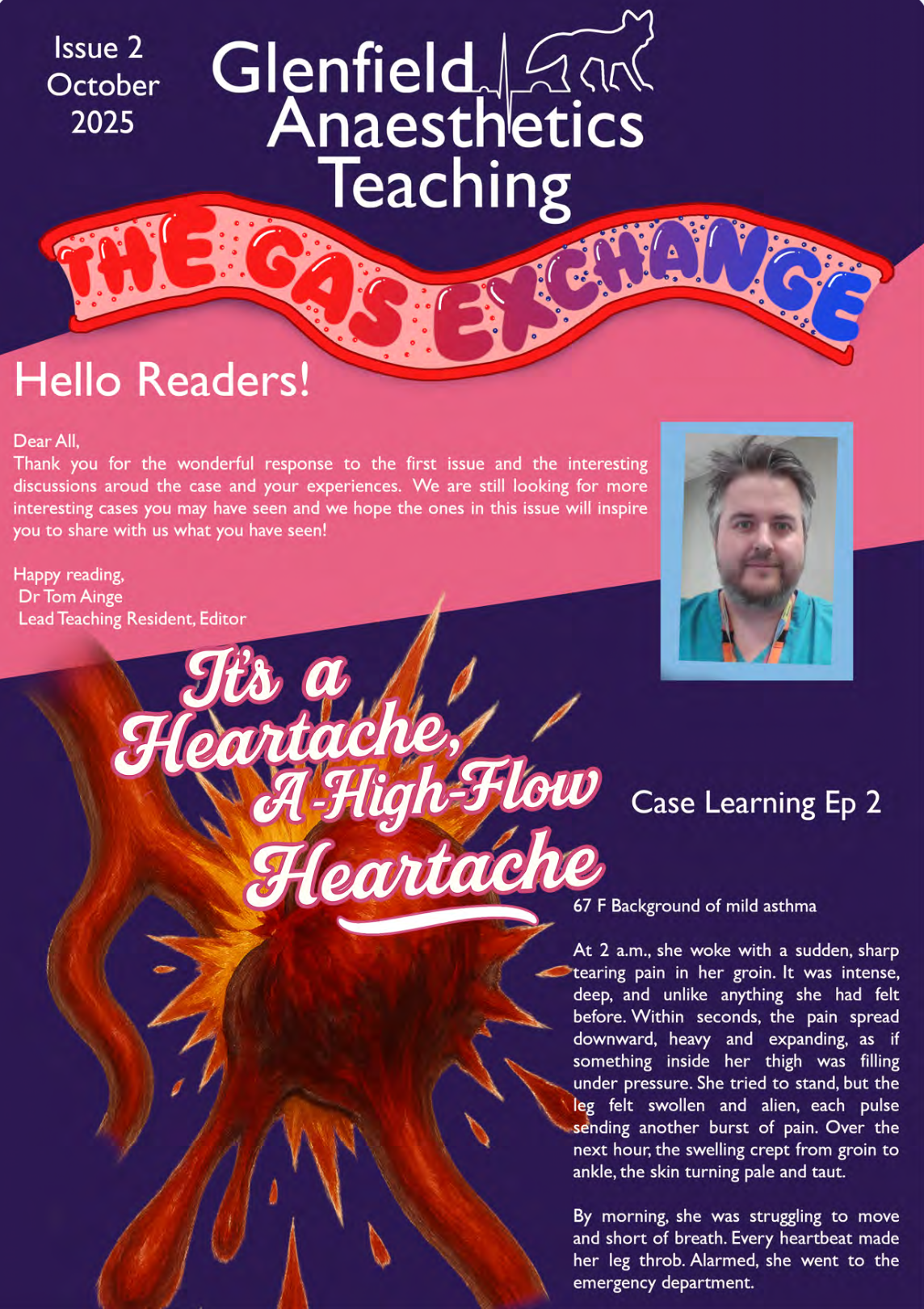
The Gas Exchange started from a frustration I had during training when I attempted to write a traditional case report. While case reports clearly have their place academically, I found the process surprisingly restrictive.
The format felt rigid and oddly disconnected from how clinicians actually talk about cases. When we discuss interesting or unusual cases with colleagues, we rarely present them in the highly structured format expected in journals. Instead, we tell stories: what happened, what made the situation unusual, the decisions that were made at the time, and what we took away from it. Those conversations tend to be engaging, memorable, and educational. The case report I was trying to write, however, felt as though it had been carefully designed to remove most of the interesting parts.
At roughly the same time, I had also found myself getting back into reading more widely again. Rediscovering the pleasure of reading reminded me how powerful storytelling can be in holding attention and making ideas stick. That made me start thinking about whether some of the same principles could be applied to medical education. If narrative works well in books, perhaps it could also work as a way of presenting clinical learning in a more engaging way.
From that idea, The Gas Exchange began to take shape. The concept was fairly simple: short, engaging pieces of educational content that can be read quickly but still leave the reader with something useful. I started to think of it as "minimally invasive education", learning that fits into the small gaps that exist during a working day rather than requiring a long uninterrupted stretch of time.
The magazine format seemed like a natural way to bring this together. It allows a mixture of content that would not normally sit side by side in a traditional journal. One article might be a narrative case discussion, another a historical vignette from the development of anaesthesia, and another a short teaching piece reflecting on clinical practice. It also has the advantage that, unlike a formal journal submission, it allows a little more creative freedom. If I want to include an illustration, a slightly tongue-in-cheek title, or a narrative style that would probably cause an editor mild palpitations, the magazine format allows for that.
Another aspect of the project has been the visual side of education. Designing layouts, creating Illustrations, and shaping the overall aesthetic has allowed me to explore how visual storytelling can complement written teaching. The aim is to produce something that feels approachable and distinctive, educational but also enjoyable enough that people actually want to read it.
Although the project started as a personal experiment, it would benefit enormously from wider involvement. Anaesthesia trainees encounter fascinating cases, practical lessons, and historical curiosities every day, yet many of these never reach a wider audience.
If the idea of The Gas Exchange sounds interesting and you would like to express interest in contributing or being involved in future issues, please feel free to get in touch. The intention is for the project to grow into something collaborative, shaped by the experiences and perspectives of trainees who want to share and develop this style of educational storytelling. Or if you feel inspired, have an idea, get it going and use your initiative!